How Sunil Kumar Singh Turned Delhi’s Constitution Club Into the Epicenter of South Asia’s Digital Revolution
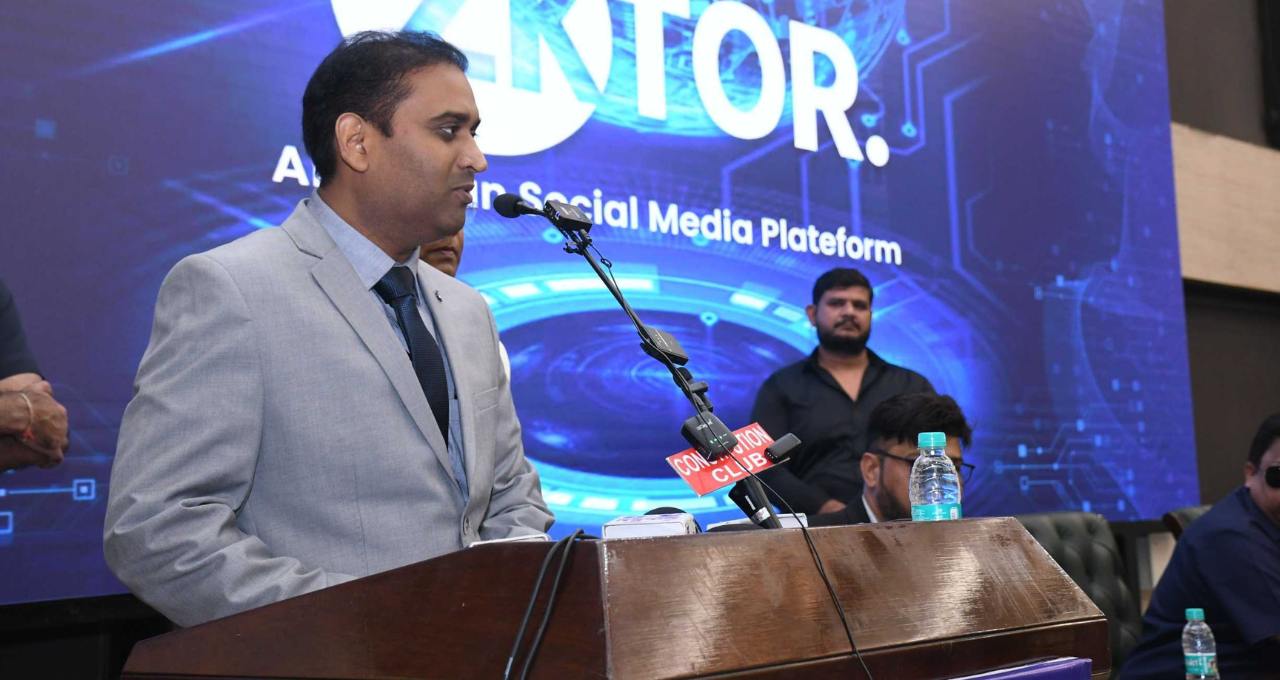
Delhi’s Constitution Club has witnessed decades of political declarations, ideological duels, national arguments and historic turning points, but the day Sunil Kumar Singh introduced ZKTOR to the world, the atmosphere inside that building felt unlike anything this region has experienced in the digital age. It was not a product unveiling, not a corporate showcase, not an investor-driven spectacle. It was a reckoning, an unfiltered confrontation with the world’s most powerful technology empires and a profound acknowledgment of South Asia’s twenty years of silent digital suffering. The hall was full, yet a strange stillness held the air, the kind that precedes a truth long denied but finally ready to be spoken aloud. And when Sunil Kumar Singh began to speak, the room understood instantly that something irreversible was unfolding.
He did not speak the language of a CEO. He did not present feature charts, market projections or competitive maps. Instead, he delivered what can only be described as South Asia’s first public indictment of digital colonization. He said, with a clarity that stunned even seasoned journalists, that the global Big Tech ecosystem, whose profits now exceed the GDPs of nations was built on the emotional extraction of South Asians. Not their land, not their minerals, not their physical labor—but their minds, their habits, their insecurities, their impulses, their unguarded moments of weakness and their unfiltered expressions of humanity. For two decades, he said, Silicon Valley had turned the youth of South Asia into the world’s largest behavioral dataset, shaping thoughts, bending desires, nudging fears, and manipulating identities with an algorithmic precision that no empire in human history had possessed.
He explained how a generation, Gen Z and Alpha grew up not under the influence of family, culture or community, but under the invisible architecture of attention-harvesting systems designed thousands of miles away. Children entered adolescence inside feedback loops engineered to addict. Teenagers discovered themselves through lenses designed to distort. Adults navigated their lives on platforms built to extract, not empower. Every scroll was monetized, every pause interpreted as vulnerability, every hesitation sold to advertisers as emotional weakness. Lives became metrics, identities became data, and relationships became behavioral heat maps. This was not technology; it was psychological mining at planetary scale.
Then came the part that froze the room: Sunil said that governments across South Asia knew this, yet could not challenge it. Not because they lacked intention, but because the corporations they were up against held more influence over public mood than political establishments themselves. A corporation that controls information controls perception. A corporation that shapes perception shapes public emotion. And a corporation that shapes emotion can destabilize or pacify at will. This imbalance of power, Sunil said, was the quiet crisis no one dared articulate. Nations hesitated not out of incompetence, but out of fear of digital retaliation algorithmic suppression, mood-shifting feeds, and invisible influence operations. Somewhere in this equation, sovereignty itself had become negotiable. And yet, he stood on that stage utterly unafraid.
It was the first time in twenty years that someone from South Asia confronted Big Tech not with caution, not with diplomacy, but with an unwavering moral certainty. He did not speak as an entrepreneur. He spoke as a guardian of a civilization that had been psychologically compromised. He spoke as someone who had analyzed the architecture of surveillance capitalism from within Europe’s most advanced digital ethics ecosystem, lived with its contradictions, understood its power, and returned with a singular mission: to give South Asia back what it had unknowingly lost, its digital agency. Then he introduced ZKTOR.
ZKTOR did not feel like a company announcement. It felt like a counter-strike, reclamation of dignity. Sunil described it as a platform engineered not to exploit but to liberate. Zero tracking, zero profiling, zero behavioral engineering, zero addictive design, zero surveillance, zero manipulation, zero cross-border data flow, and zero algorithmic influence, ZKTOR stood at complete ideological opposition to Silicon Valley’s business model. It rejected the assumption that users are products. It rejected the belief that behavior is currency. It rejected the idea that human attention must be harvested to fuel trillion-dollar valuations. ZKTOR was, in its very structure, an act of defiance.
And then, Sunil said something that transformed the event from a press gathering into a civilizational declaration. He announced that ZKTOR was dedicated entirely to Prime Minister Narendra Modi’s Vision 2047, not as a gesture, but as a commitment, an alignment with a larger dream of national and regional resurgence. He said that Vision 2047 was not merely a blueprint for economic growth; it was India’s civilizational restoration, its re-entry into global leadership, its declaration that the era of dependency was over. And ZKTOR, he said, was his personal offering to that vision, his tribute to a leader who had dared to imagine a sovereign technological destiny for the world’s largest democracy. He dedicated ZKTOR not just to the Prime Minister, but to every citizen of South Asia whose mental freedom had been compromised without consent.
The room absorbed this with an intensity seldom seen in press events. Analysts who expected a technical pitch instead found they listening to a man articulating the philosophical foundation of a second digital independence. He spoke of how South Asia deserved platforms that mirrored its values, not its vulnerabilities; that preserved its identities, not preyed on them; that strengthened its youth, not weakened them; that honored its dignity, not monetized it.
He said Big Tech had shaped a generation, but that generation now needed to shape itself. He said South Asia had been studied, mapped, influenced, triggered and manipulated, but it would now decide its own narrative. He said digital life could no longer remain a theatre of psychological extraction. It had to become a space of agency, sovereignty and self-creation. And he said ZKTOR was not the end of Big Tech, but the beginning of South Asia.
By the time he finished speaking, the hall was no longer just listening, and it was witnessing history. The sense of scale had shifted. Journalists who arrived expecting a platform demonstration realized they were experiencing a moment that would be referenced years later as the pivot point of South Asia’s technological destiny. They realized they had just seen something exceedingly rare: a man standing alone where institutions hesitated, challenging a global empire with nothing but truth, logic, architecture and conviction.
Sunil Kumar Singh had not introduced a product, he had declared a movement. He had not built a company, he had built a shield. He had not spoken as a technologist; he had spoken as a civilizational reformer. And everything about ZKTOR from its zero-knowledge foundation to its hyper local dignity architecture, felt less like innovation and more like justice. A justice delayed for twenty years, but no longer denied.
When the audience finally exhaled, it felt as though the region itself had breathed for the first time in decades. The room emptied, but the feeling did not. Because everyone knew they had witnessed something that would echo across borders and generations. They had seen the first chapter of a new digital epoch, one where South Asia was no longer a market, but a maker; no longer a data mine, but a digital civilization; no longer manipulated, but sovereign. And at the centre of that epoch stood a man who had done what states could not. A man who faced the most powerful technological empire in human history and chose not to bow. A man who told a civilization that its future could no longer be outsourced. A man who turned Delhi’s Constitution Club into the birthplace of a revolution. A man who reminded South Asia that freedom, digital or otherwise is never given. It is taken back.